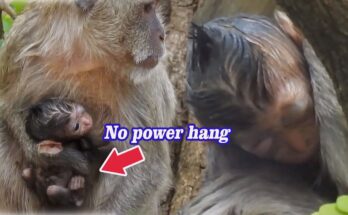
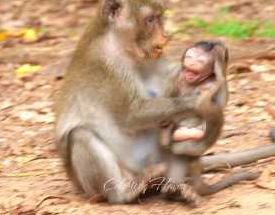
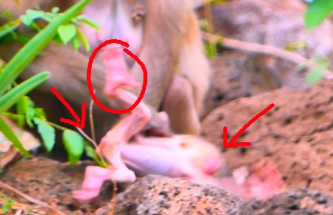
The bond between a mother and her offspring is often seen as one of the strongest forces in nature. In many species, mothers go to great lengths to protect and nurture their young. However, in the wild, instances of maternal abandonment—where a mother monkey leaves her infant—can be observed. This seemingly heartbreaking behavior raises an important question: why do some mother monkeys abandon their little ones?
The Harsh Realities of Survival
One of the primary reasons for maternal abandonment in monkeys is survival. The natural world is unforgiving, and raising an infant requires a significant amount of energy. If a mother is weak, malnourished, or struggling to find food, she may lack the resources needed to care for her baby. In such cases, abandoning the infant may be a heartbreaking but necessary decision to increase the mother’s chances of survival and, potentially, her ability to reproduce again in the future.
Infant Health and Weakness
Another reason why a mother monkey may abandon her offspring is the health of the infant. In the wild, only the strongest survive. If a baby monkey is born sick, deformed, or too weak to thrive, the mother might instinctively reject it. This behavior, though difficult to witness, is an example of natural selection at work. By focusing her energy on healthier offspring in the future, the mother increases the overall survival chances of her genes.
Social Hierarchy and Competition
Monkeys live in complex social groups where dominance and hierarchy play a crucial role. Low-ranking mothers may face bullying, aggression, or resource deprivation from higher-ranking individuals. If a mother is unable to secure enough food or safety due to her social status, she may be forced to abandon her infant because she cannot provide for it. Additionally, in some species, dominant females may even attack or kill the offspring of lower-ranking mothers to reduce competition.
First-Time Mothers and Inexperience
Young or first-time monkey mothers may also abandon their infants due to inexperience. Parenting is a learned behavior, and some mothers simply do not know how to properly care for their young. Without the right maternal instincts or guidance from experienced females in the group, a new mother may inadvertently neglect or abandon her baby. In some cases, such mothers may become better caregivers with future offspring.
Human Influence and Environmental Stress
Unfortunately, human activities also contribute to maternal abandonment in some monkey populations. Habitat destruction, climate change, and food shortages caused by human expansion can put tremendous stress on primate groups. In unnatural conditions—such as captivity or areas with heavy human interference—monkeys may display unusual behaviors, including increased rates of infant neglect or abandonment.
Conclusion
While it may seem cruel, maternal abandonment in monkeys is often a result of natural and environmental pressures. Whether it is due to survival instincts, infant health, social competition, inexperience, or human-induced stress, this behavior serves an evolutionary function. Understanding the reasons behind maternal abandonment can help researchers and conservationists develop strategies to protect primate populations and their habitats. Though nature can be harsh, every action within the animal kingdom plays a role in the delicate balance of survival.